EVENTS
Cosmologies. Rethinking Anomalies in Urban and Architectural Research on China and Beyond
MAR-DEC 2026
Conceived to mark the ten-year anniversary of China Room, this series of events – or, more precisely, collective reflections – invites researchers and practitioners to rethink, together, the contemporary spatial, social, and architectural transformations unfolding in China and beyond.
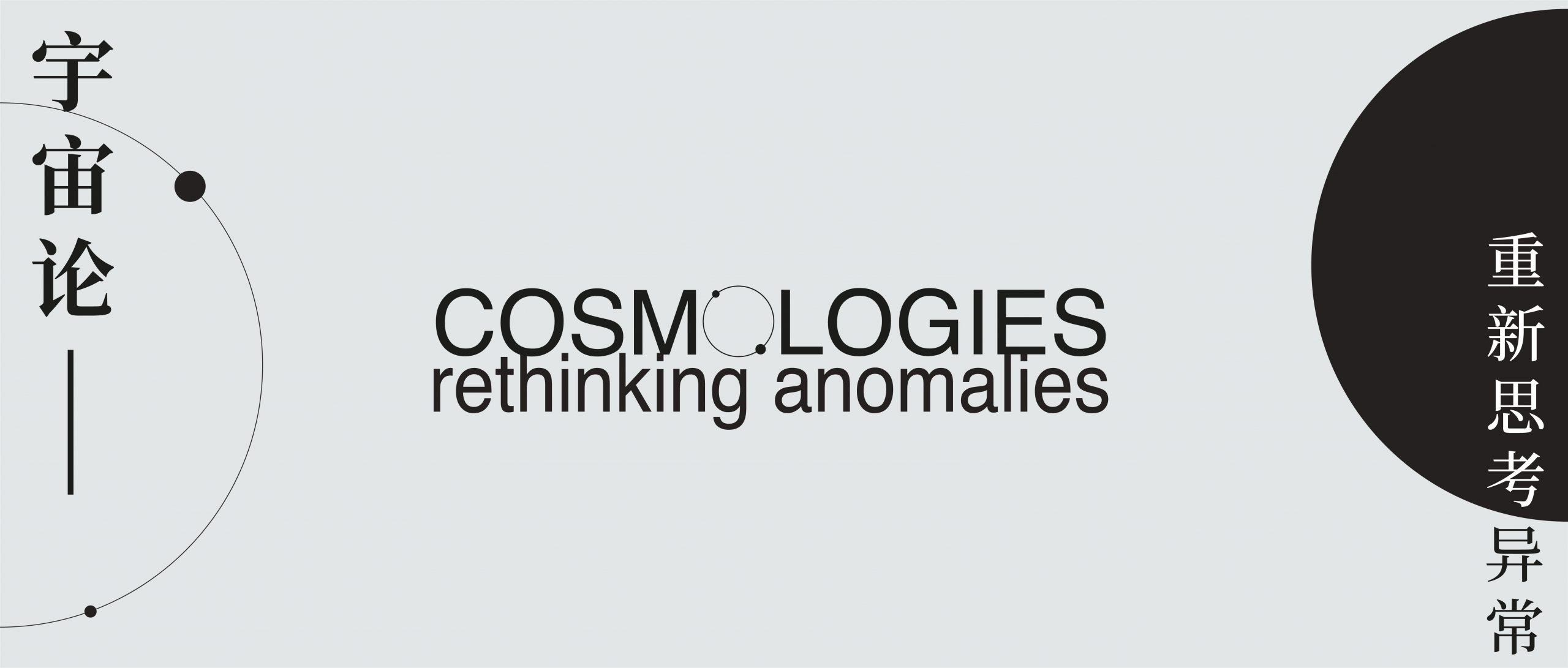

The cycle “COSMOLOGIES. Rethinking Anomalies in Urban and Architectural Research on China and Beyond” unfolds as a series of meetings, conceived as moments of openness, discussion, and exchange leading up to the celebration of the group’s tenth anniversary, which will culminate in a major International Conference on January 20–22, 2027.
Through the notion of Cosmologies, the initiative proposes to rethink anomalies in urban and architectural research not as exceptions, but as manifestations of plural and coexisting worlds, capable of critically interrogating the contemporary spatial, social, and architectural transformations unfolding in China and, more broadly, within the global context.
The three main themes are: Global Ruralism(s), Architectural Knowledge, and Infrastructure-led Urbanization.
The program is structured into 10 meetings, organized as follows:
- #ReadingLabs, conceived as experimental spaces for reflection and critical exchange;
- #Talks with Víctor Muñoz Sanz, Zhengli Huang, Stephan Petermann, and Merve Bedir, international guests addressing the same themes, but mobilizing different geographies, scales, disciplines, and experiences.
- #Movie Screenings, designed to open the discussion from the wider academic community to the general public.
Anomaly has too often been the lens through which China is read: its economic acceleration, its urbanisation, its architectures, and its institutional configurations have been framed as deviations – exceptions explainable only through the familiar formula with Chinese characteristics.
This has produced an interpretative habit rooted in a binary logic in which China is positioned as the Other of presumed universal models. Since its foundation, China Room has worked to rethink this dichotomy, insisting instead that understanding China requires abandoning the language of exception and recognising how “localised specificities surpass local transformation processes,” generating insights that extend far beyond their immediate contexts.
Cosmologies becomes an opportunity to open our research toward a broader academic community, within Politecnico and beyond, across disciplines, practices, and modes of knowledge production, in order to cultivate analytical tools capable of situating China within global processes. Resisting anomalies thus becomes a methodological stance: a way of expanding the horizons of spatial and architectural thought by refusing reductive framings and embracing the complexity of China’s entanglements with the world.
Each Cosmology, or better say each topic or event, marks a point of conjuncture within a decade-long trajectory of research: some stem from earlier projects, others signal new lines of inquiry opening within our fields.
The term Cosmologies is used here not only in a metaphorical sense, but also as a critical lens. In contemporary anthropology, sociology, and critical studies, cosmologies are increasingly understood as ontological arrangements: situated ways of composing the world that define how humans, non-humans, environments, institutions, and forms of knowledge are related and made operative.
Cosmologies is employed here as a critical concept referring to plural ontological frameworks through which the world is composed and understood. Rather than treating non-Western contexts as deviations from universal models, this perspective recognizes modernity itself as a historically and geographically situated cosmology, one among others, rather than a neutral or universal horizon. Framing urban and architectural research through Cosmologies allows us to rethink anomalies not as exceptions, but as manifestations of diverse and coexisting modes of world-making, extending well beyond the case of China.


COMING SOON!
14th OCTOBER 2026
#05 TALK
— Zhengli Huang
Global China and Urban Africa: Infrastructure, Connectivity and Emergent Urbanisms. Tracing two decades of fluctuating Chinese infrastructure investment in Africa, this talk examines its changing scale and geography before turning to connectivity projects in Kenya. Through cases of Chinese-financed rail and road projects, it explores their urban impacts and how these investments contribute to emergent African urbanisms shaped by shifting global relations and local dynamics.
About the Guest
Zhengli Huang, PhD, is an urban researcher and Marie Skłodowska-Curie Postdoctoral Fellow in the Interuniversity Department of Regional and Urban Studies and Planning (DIST) at Politecnico di Torino. Prior to joining Politecnico di Torino, she was a Research Associate at the Urban Institute, University of Sheffield, working on projects examining global infrastructure corridors and China’s role in low-carbon transitions. Her research over the past decade has examined Chinese-financed infrastructure, urban development and territorial transformation across African cities, with extensive fieldwork in East and Southern Africa.
Introduced by Giorgia Greco (DAD) and Francesca Governa (DIST) in dialogue with Emanuele Sciuva (DIST).
DATE: October 14th 2026, from 3:00pm
VENUE: Ex Cappella, Castello del Valentino, Politecnico di Torino
LANGUAGE: English
ONLINE: https://polito-it.zoom.us/j/84415819786
ON THE WAY…
#06 READING LAB
— Infrastructure-led Urbanization
The roundtable examines the spatial and social dimensions of infrastructure-led urbanisation through critical cartography and visual methods. Since the early 2000s, China’s rapid urban and economic expansion has been driven to a large extent by infrastructure, and urban policy has shifted from the centripetal growth of major cities through new towns towards a centrifugal urbanisation that pursues regional integration through wide-area projects and small-scale interventions. Infrastructure-led urbanities explores the urban afterlives of Chinese-related infrastructure projects. As geopolitical conditions shift, this session examines how initiatives such as the Belt and Road reshape cities beyond their initial moment of expansion. The roundtable focuses on emerging infrastructure-led urbanities, the urban projects and design visions that frame them, and the multiple temporalities (delay, anticipation, incompletion) through which infrastructure produces lasting spatial, governance, and social transformations.
Reading labs are conceived as experimental spaces for collective reflection, open debate and critical exchange among PhD researchers and scholars. The event is open and free. To participate and receive the materials, please write to cosmologies@polito.it
Moderated by Sofia Leoni (DIST) and introduced by Leonardo Ramondetti (DIST).
DATE: November 13th, from 2:30pm
VENUE: Sala Vigliano, Castello del Valentino, Politecnico di Torino
LANGUAGE: English
ONLINE: https://polito-it.zoom.us/j/84415819786


ON THE WAY…
#07 TALK
— Stephan Petermann
In this talk, Stephan Petermann addresses a profession in flux. Architecture is going through a period of structural instability, shaped by volatile markets, increasingly hybrid roles and a steady expansion of the fields in which architects operate. China offers a particularly revealing lens on these dynamics: the contraction of the real estate sector has deeply affected the profession and, in turn, architectural education. Rather than reading this condition as a crisis, Petermann treats instability as fertile ground for debate, a space where architectural knowledge, teaching and professional identities are being renegotiated. Starting from the Chinese case and moving across other contexts, the talk explores how changing professional realities are reshaping the disciplinary boundaries.
About the Guest
Stephan Petermann holds a Master’s degree in the History of Architecture and the Theory of Building Preservation from the University of Utrecht (2001-2007) and studied Architecture at the Technical University of Eindhoven (2001-2005). He worked for architecture magazine VOLUME in 2005 and joined OMA in 2006 assisting OMA’s founder Rem Koolhaas with lectures, texts and research projects. In 2014 Petermann became one of the associates in charge of Koolhaas’ Fundamentals Architecture Biennale in Venice on the Elements of Architecture exhibition. He is one of the editors-in-chief of the Elements of Architecture published in 2018. He is currently a visiting professor at the CAFA Visual Arts Innovation Center in Beijing where he is conducting research into the future of the Chinese Countryside with Rem Koolhaas, CAFA Dean Zhu Pei and Dongmei Yao. He was a guest critic and visiting expert at the AA in London (2020), Domus Academy in Milan (2020), Knowlton School of Architecture in Ohio (2017), Berlage Institute in Delft (2020), and the Amsterdam Academy of Architecture (2021). He is currently working on various projects related to the future of agriculture, economy, history, planning, and office buildings.
Introduced by Giorgia Greco (DAD) and Alp Arda (DAD) in dialogue with Michele Bonino (DAD).
DATE: December 2nd 2026, from 3:00pm
VENUE: Sala dello Zodiaco, Castello del Valentino, Politecnico di Torino
LANGUAGE: English
ONLINE: https://polito-it.zoom.us/j/84415819786
ON THE WAY…
#08 MOVIE SCREENING
— Dead Pigs (2018)
Through a screening of Cathy Yan’s Dead Pigs, we aim to explore the theme of urban and social transformation in contemporary China, seen through the everyday experiences of people who occupy very different positions within the city. Set in a Shanghai undergoing rapid processes of modernization, the film weaves together the stories of several characters, staging the tensions between real estate development and the persistence of existing urban fabrics, between emerging economic inequalities and individual aspirations, and between shifting modes of dwelling and collective life. The narrative thus becomes a backdrop against which to interrogate the relationship between urban growth, infrastructure, environment, and collective responsibility.
The choice of this film is closely tied to the research interests of China Room, which for the past ten years has studied the architectural, territorial, and urban processes of China and their global connections. Dead Pigs offers a way of approaching these themes through an accessible cinematic language, one capable of pairing a reflection on the transformation of space with a reading of the social and cultural relations that accompany it — from the displacement of long-standing communities to the emergence of new forms of urban aspiration and precarity.
The screening will be followed by a moment of open discussion involving faculty, researchers, students, and members of the public, with the aim of examining cinema not merely as a representation of the city, but as a genuine tool of research and critical interpretation of contemporary urban processes — one that can complement more traditional architectural and planning-based approaches to understanding China’s rapidly changing urban landscape.
DATE: December 3rd
VENUE: TBD
LANGUAGE: English


ON THE WAY…
#09 TALK
— Merve Bedir
About the Guest
Merve Bedir is an architect based in Rotterdam. Her ongoing research examines infrastructures of hospitality and mobility, and the human and nonhuman relationships in the context of ecology and cybernetics. She is the co-founder of Aformal Academy (an experimental school program in Pearl River Delta region), a founding member of Mutfak مطبخ Workshop (focusing on Kitchen as a cultural space in Gaziantep), and a founding member of Center for Spatial Justice in Istanbul. Merve Bedir holds a PhD from Architectural Engineering Department in Delft University of Technology, and a BArch from Middle East Technical University in Ankara. She has taught at Hong Kong University, Delft University, and Columbia GSAPP. She is currently a fellow at BAK, Utrecht. Merve curated uncommon river (Plovdiv, Bulgaria, 2015), Vocabulary of Hospitality (Istanbul, 2015), and Automated Landscapes (Shenzhen, 2017 and 2019). Most recently her work Unsettled Urbanism was invited to be exhibited in Matadero Madrid (2020), and Venice Architecture Biennale’s main exhibition (2020/2021). Merve is the editor of New Silk Roads series in e-flux architecture together with Nick Axel and Nikolaus Hirsch (2018).
DATE: December 18th 2026, from 10:00am
VENUE: Sala dello Zodiaco, Castello del Valentino, Politecnico di Torino
LANGUAGE: English
ONLINE: https://polito-it.zoom.us/j/84415819786
…PREVIOUS EVENTS
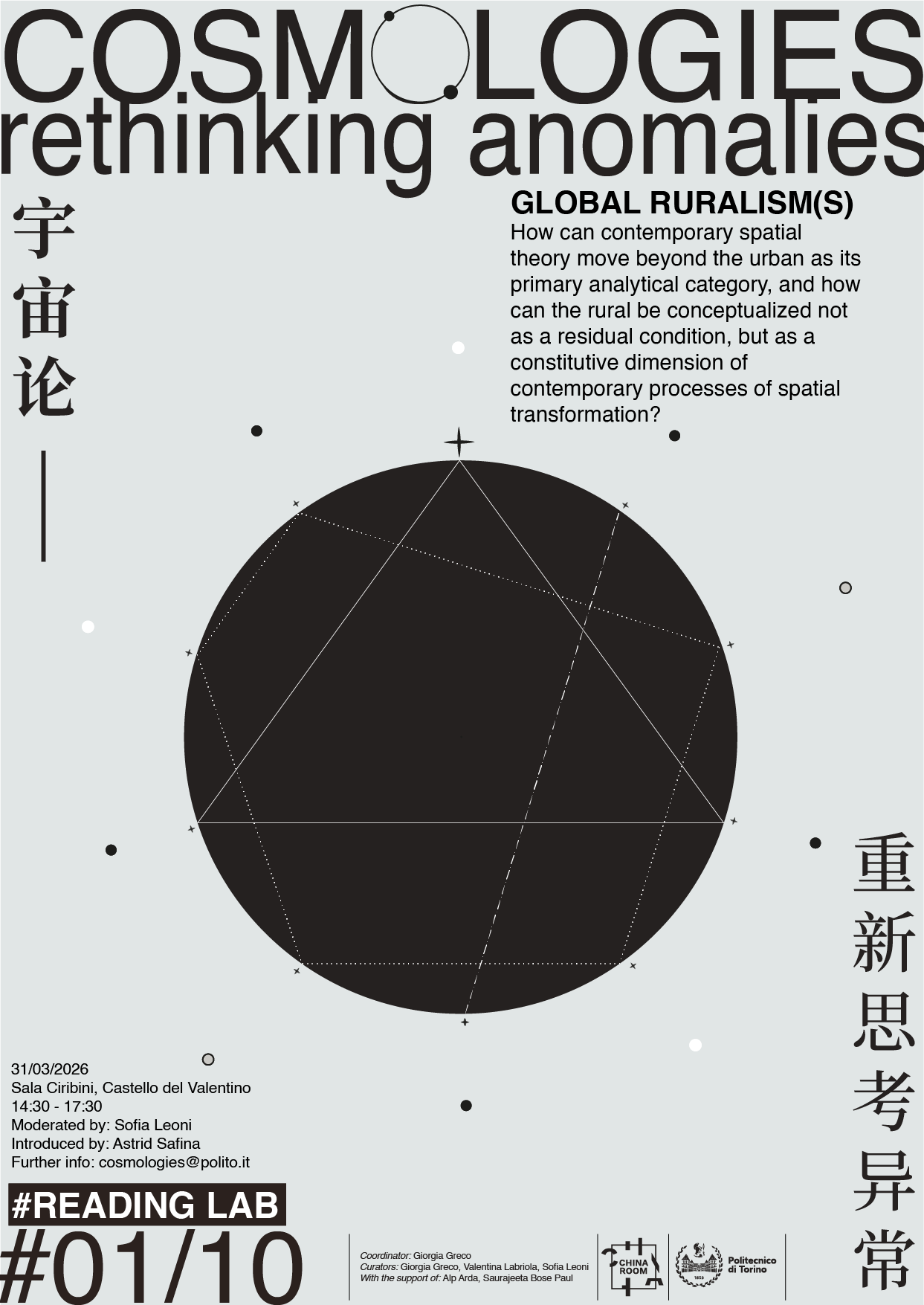
#01 READING LAB
— Global Ruralism(s)
What is rural space today, particularly when examined from a planetary perspective? How might it be theorized beyond metro-normative paradigms and approached as a space in its own right?
This roundtable takes these questions as its point of departure, engaging a set of selected articles as conceptual anchors. Rather than casting the rural as peripheral, residual, or derivative of the urban, the discussion positions it as a generative spatial condition, structured by its own logics, infrastructures, temporalities, and capable not only of being interpreted, but of producing theory in its own terms.
Reading labs are conceived as experimental spaces for collective reflection, open debate and critical exchange among PhD researchers and scholars. The event is open and free. To participate and receive the materials, please write to cosmologies@polito.it
Moderated by Sofia Leoni and introduced by Astrid Safina.
DATE: March 31, from 2:30 to 4:30 PM
VENUE: Ciribini Room, Castello del Valentino, Politecnico di Torino
LANGUAGE: English
ONLINE: https://polito-it.zoom.us/j/84415819786
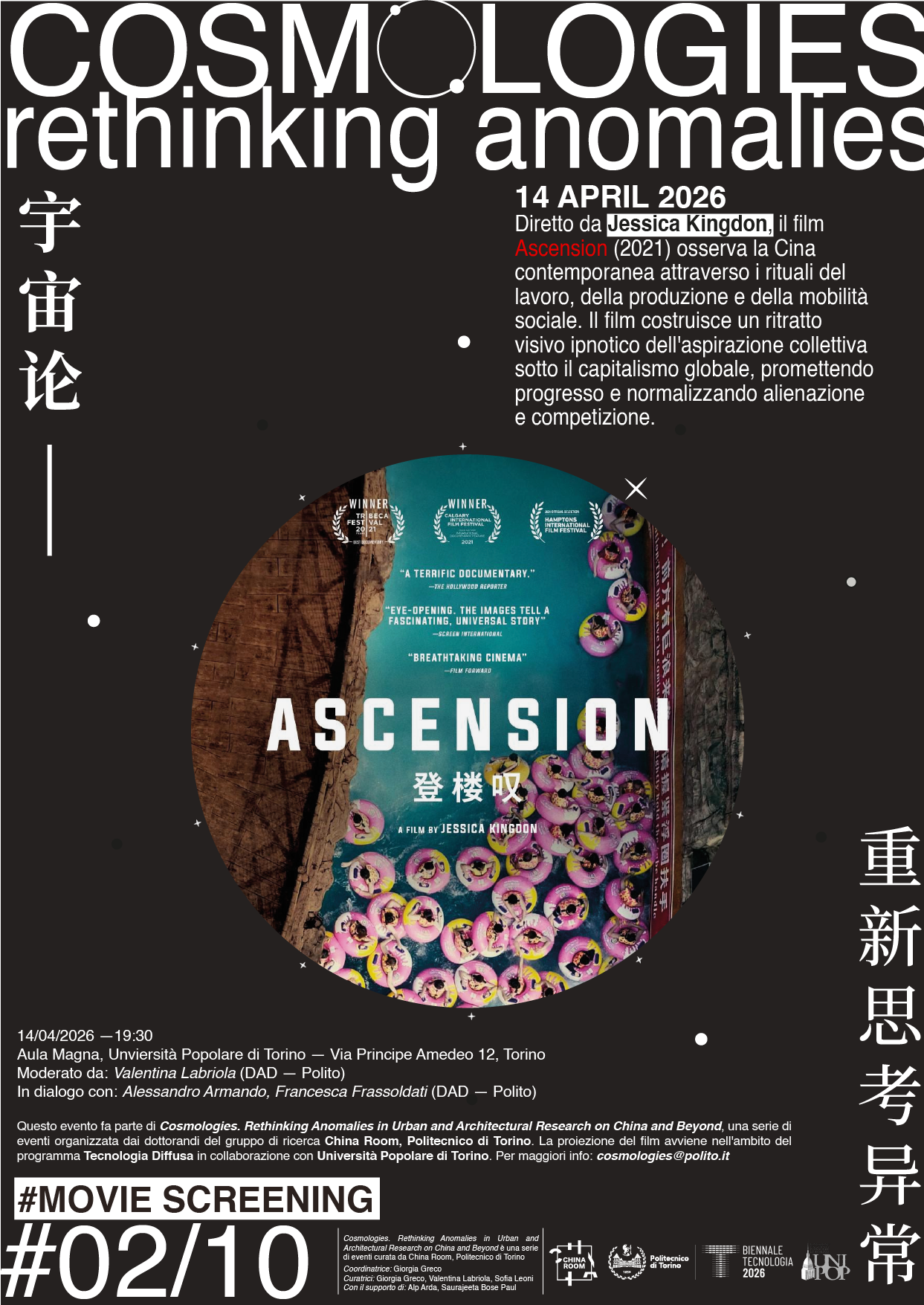
#02 MOVIE SCREENING — Ascension (2021)
Directed by Jessica Kingdon, the movie “Ascension” (2021) observes contemporary China through rituals of labor, production, and social mobility. The film builds a hypnotic visual portrait of collective aspiration under global capitalism, proising progress while normalizing alienation and competition.
The event consists of selections from the film guided by a critical discussion of the themes addressed, inviting the audience to explore the boundaries between design, technology, and society, and to question the visual languages through which collective aspirations are constructed.
This event is held in the Tecnologia Diffusa framework within Biennale Tecnologia and it is proposed in partnership with Università Popolare di Torino. The access is free and open until full capacity. To participate please write to cosmologies@polito.it
Moderated by Valentina Labriola in dialogue with Alessandro Armando (DAD) and Francesca Frassoldati (DAD)
DATE: April 14, from 7:30 PM
VENUE: Aula Magna, Università Popolare di Torino — Via Principe Amedeo 12
LANGUAGE: Discussion in Italian, movie in Chinese with Italian subtitles
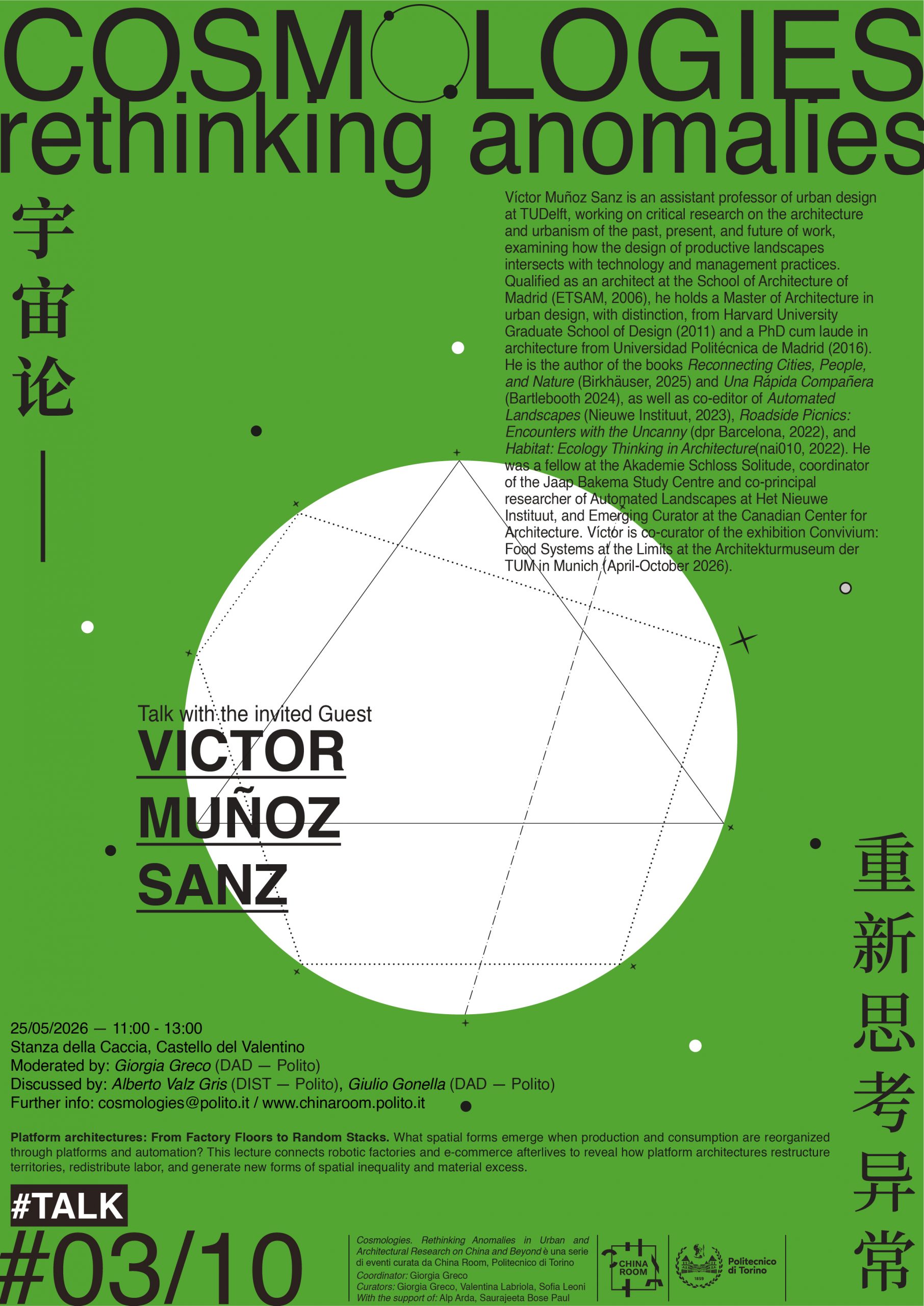
#03 TALK
— Víctor Muñoz Sanz
Platform Architectures: From Factory Floors to Random Stacks
What spatial forms emerge when production and consumption are reorganized through platforms and automation? This lecture connects robotic factories and e-commerce afterlives to reveal how platform architectures restructure territories, redistribute labor, and generate new forms of spatial inequality and material excess.
About the Guest
Víctor Muñoz Sanz is an assistant professor of urban design at Delft University of Technology. He conceptualizes, leads, and develops critical research on the architecture and urbanism of the past, present, and future of work, examining how the design of productive landscapes intersects with technology and management practices. Víctor qualified as an architect at the School of Architecture of Madrid (ETSAM, 2006) and holds a Master of Architecture in urban design, with distinction, from Harvard University Graduate School of Design (2011) and a PhD cum laude in architecture from Universidad Politécnica de Madrid (2016). He is the author of the books Reconnecting Cities, People, and Nature (Birkhäuser, 2025) and Una Rápida Compañera (Bartlebooth 2024), as well as co-editor of Automated Landscapes (Nieuwe Instituut, 2023), Roadside Picnics: Encounters with the Uncanny (dpr Barcelona, 2022), and Habitat: Ecology Thinking in Architecture(nai010, 2022). Prior to his current position at Delft, he was a fellow at the Akademie Schloss Solitude, coordinator of the Jaap Bakema Study Centre and co-principal researcher of Automated Landscapes at Het Nieuwe Instituut, and Emerging Curator at the Canadian Center for Architecture. Víctor is co-curator of the exhibition Convivium: Food Systems at the Limits at the Architekturmuseum der TUM in Munich (April-October 2026).
Moderated by Giorgia Greco in dialogue with Alberto Valz Gris (DIST) and Giulio Gonella (DAD)
DATE: May 25th, from 11:00 AM
VENUE: Stanza della Caccia, Castello del Valentino, Politecnico di Torino
LANGUAGE: English
ONLINE: https://polito-it.zoom.us/j/84415819786

#04 READING LAB
— Architectural Knowledge and the Design Studio
How is architectural knowledge learned, practiced, and transmitted? Which pedagogical devices support critical reflection and the development of new forms of spatial and collaborative imagination—both in the design studio and beyond it?
This roundtable examines how architectural knowledge is produced through educational practice. With a focus on design studios, it considers learning as a situated process shaped by observation, discussion, making, and engagement with the built environment. While architectural curricula are often organized around distinct domains of expertise, the design studio remains the place where these forms of knowledge converge, are negotiated, and are tested through project-based inquiry. Building on discussions around competency-based learning and the pedagogical model of the bottega, the roundtable considers the studio as a teaching format and a space in which students develop situated judgment, critical reflection, spatial imagination, and collaborative practice. At the same time, it invites reflection on the power relations embedded in studio culture, the assumptions that underpin architectural knowledge, and the ways in which pedagogical practices can either reproduce or challenge existing social, cultural, and professional hierarchies. Particular attention will be given to the relationship between design studios and site visits as complementary pedagogical devices. By engaging with the built environment, students connect theoretical concepts to material, social, political, and spatial realities, developing forms of embodied and experiential knowledge.
To participate and receive the materials, please write to cosmologies@polito.it
Moderated by Sofia Leoni and Valentina Labriola in dialogue with Sarah Becchio + Paolo Borghino (ErranteArchitetture, DAD), Luca Mostarda (AMArchitectrue, ETHZ, DAD), and Yan Yu (School of Architecture and Urban Planning, Shenzhen University)
DATE: June 22nd, from 11 AM
VENUE: Sala Astengo, Castello del Valentino, Politecnico di Torino
LANGUAGE: English
ONLINE: https://polito-it.zoom.us/j/84415819786
CREDITS
Scientific Curatorship: Giorgia Greco (main coordinator), Valentina Labriola, Sofia Leoni
Team: Alp Arda, Saurajeeta Bose Paul
Talks: Giorgia Greco
Reading Lab: Sofia Leoni
Movie Screening: Valentina Labriola
Graphics: Giorgia Greco, Alp Arda